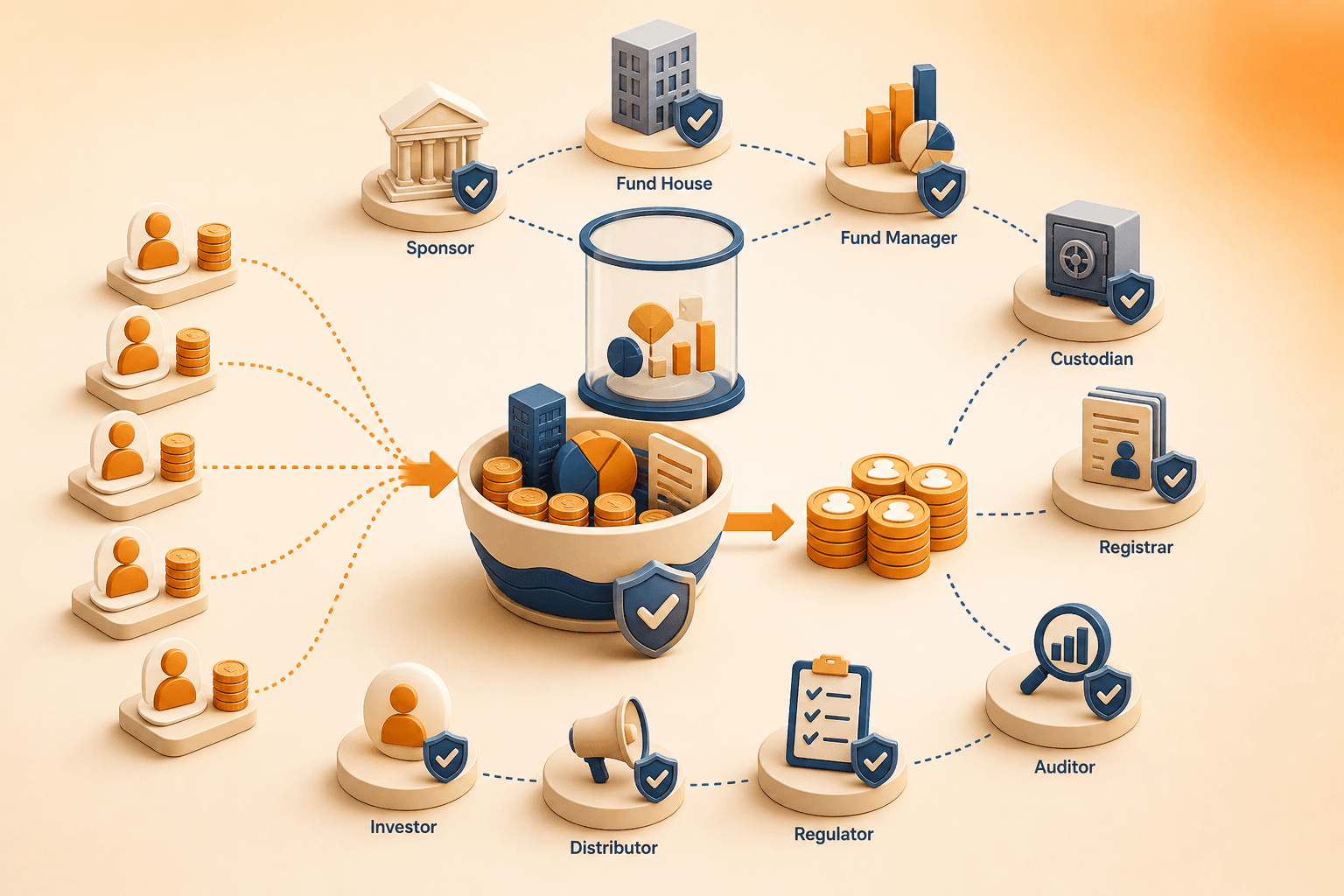
Auditors independently examine financial statements and controls, helping identify whether records and reporting fairly reflect the scheme's affairs.
The short version
Learn the meaning first, verify how the concept works in the relevant product or portfolio, then connect it to a stated goal. A useful conclusion always records its assumptions and limitations.
Detailed explanation
Understanding the concept in context
This topic belongs to mutual fund structure. The wider module context is: Explore the governance and regulatory ecosystem including SEBI regulations, AMFI roles, AMCs, Fund Managers, Trustees, and RTAs.
A strong understanding separates the name of the concept from its mechanics. Trace the participants, assets, cash flows, source of return, and source of risk before deciding what the idea means in practice.
The simplified textbook version is a starting point. Real outcomes can also be affected by inflation, time, fees, liquidity, tax, regulation, investor behaviour, and changing market conditions.
For an investor, this concept becomes actionable only after it is connected to a named goal, suitable time horizon, liquidity requirement, capacity for loss, existing portfolio, and current source documents.
Core meaning
Auditors independently examine financial statements and controls, helping identify whether records and reporting fairly reflect the scheme's affairs.
Where it fits
This topic is part of Module 4, Mutual Fund Structure, and should be studied alongside the other concepts that shape the same decision.
Decision use
Be able to define the concept in your own words and illustrate it with a simple numerical or real-life example.
Important limitation
Do not treat a simplified definition as the whole decision. Real products and investor circumstances add costs, constraints, uncertainty, and regulation.
Learning objectives
What you will understand
Explain the idea in plain language without relying on a memorised definition.
Identify the people, assets, cash flows, rules, and risks involved.
Connect the concept to a real investor goal or mutual-fund decision.
Investor relevance
Why this topic matters
A correct foundation prevents later decisions from being built on misleading shortcuts. This concept supplies vocabulary and reasoning used throughout the remaining course.
The concept should never be viewed in isolation. Its practical meaning depends on the investor's goal, time horizon, liquidity needs, ability to absorb loss, other holdings, costs, and the quality and date of the evidence being used.
Step-by-step method
How to evaluate and apply it
- 1
Start with the definition and underline every term that needs a separate explanation.
- 2
Draw the mechanism as a simple flow: who contributes, who manages, what changes value, and who receives the outcome.
- 3
Create one small numerical or everyday example and state the assumptions used.
- 4
Compare the concept with its closest alternative so the boundary between them is clear.
- 5
Finish by recording one benefit, one risk, and one situation where the concept may be unsuitable.
Worked learning example
Turning the concept into evidence
A learner first writes a one-sentence definition, then draws the movement of money and ownership through the relevant participants. They attach the idea to a sample goal, compare it with the nearest alternative, and finish with the conditions that would make the conclusion change.
The output is a documented conclusion—not an automatic buy, sell, or switch instruction.
Learning worksheet
Questions and evidence to record
| Dimension | Question to answer | Evidence to retain |
|---|---|---|
| Meaning | Can the concept be explained in one sentence? | Definition in the lesson or official investor material |
| Mechanics | Who or what creates the outcome? | Cash-flow, ownership, or market-process map |
| Investor use | Which goal or decision could it support? | Goal, horizon, liquidity, and risk notes |
| Limit | When can the simple explanation break down? | Costs, regulation, uncertainty, and product documents |
Watch-outs
Common mistakes
Memorising a definition without understanding the mechanism behind it.
Assuming a benefit applies to every investor or every market environment.
Ignoring costs, liquidity, tax, inflation, and the possibility of loss.
Do not treat a simplified definition as the whole decision. Real products and investor circumstances add costs, constraints, uncertainty, and regulation.
Practical exercise
Put the concept into practice
Add this participant or rule to a mutual-fund ecosystem diagram and record who appoints it, what it controls, and how it protects investors.
Lesson summary
Key takeaways
Auditors independently examine financial statements and controls, helping identify whether records and reporting fairly reflect the scheme's affairs.
Be able to define the concept in your own words and illustrate it with a simple numerical or real-life example.
Connect this concept to the goal, time horizon, liquidity need, and risk capacity before using it in an investment decision.
Educational content—not a personal recommendation
Mutual-fund investments involve risk. Scheme, tax, and regulatory rules can change, and suitability depends on personal facts. Check current official documents and obtain qualified advice when needed.